
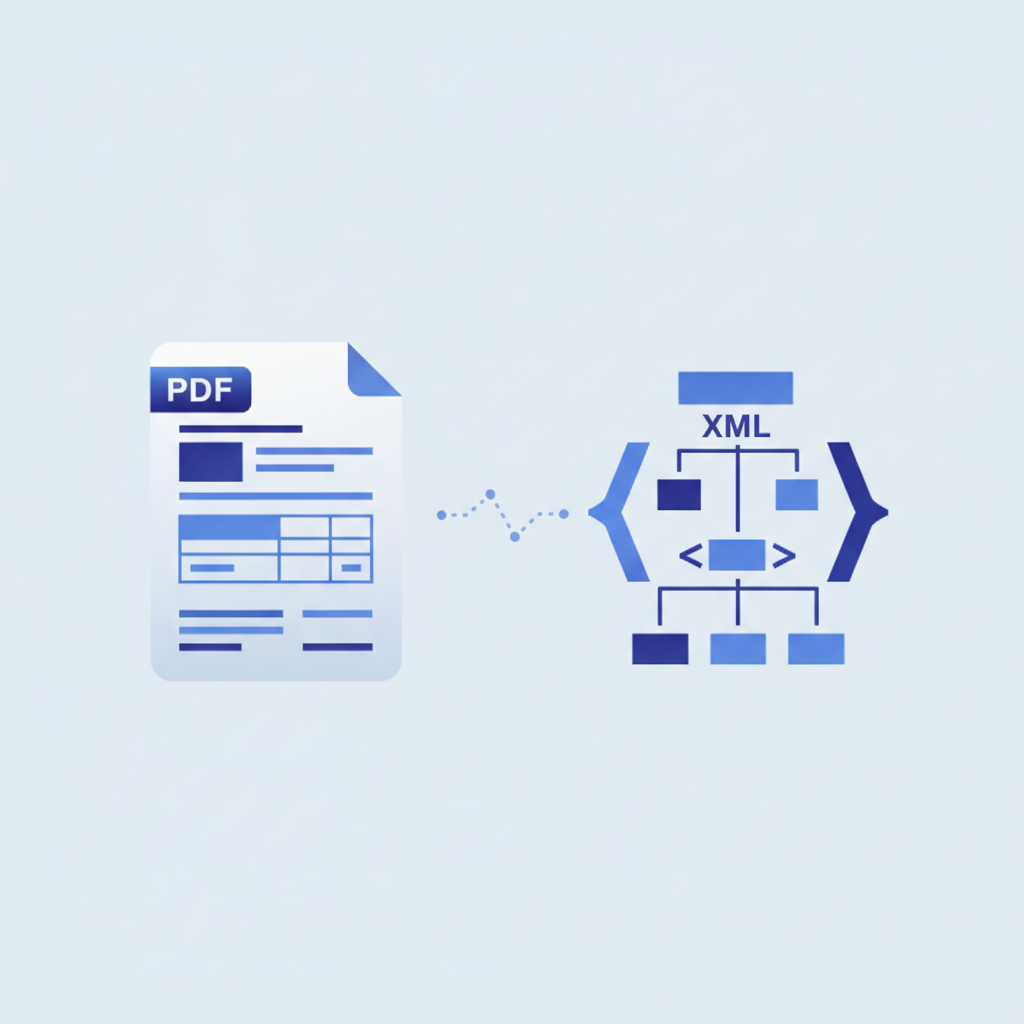
E-invoicing is the exchange of invoice data in a machine-readable structured format between a supplier and a buyer, so no human has to re-key numbers from a PDF. Unlike a scanned PDF or an emailed Word document, a true e-invoice carries data in a defined schema (XML, JSON, or a hybrid) that accounting systems can read and validate automatically. Invoscope sits alongside this world as the extraction layer for businesses that receive a mixture of compliant e-invoices and the many ordinary PDFs, scans, and images that still make up most real AP queues.
E-Invoice vs PDF Invoice: What Actually Differs
Most people use the word "e-invoice" loosely to mean any invoice that arrives digitally. Regulators and technology vendors mean something more specific: a document where every field (amount, tax, line items, supplier ID) exists as tagged structured data, not as pixels on a page.
A PDF emailed by your supplier looks digital, but the numbers live inside an image layer or unstructured text. A processor still has to read it, whether that is a human or an OCR engine. A true e-invoice in Peppol BIS or XRechnung format arrives as an XML file with named fields a system can parse without any OCR at all.
That distinction matters a lot for compliance mandates. Several countries now require structured e-invoicing for B2B or B2G (business-to-government) transactions, and more are coming online every year.
Major Global E-Invoicing Standards
There is no single world standard. Each region or country has built its own specification, though Peppol is emerging as the closest thing to a common network layer. Here is how the main ones compare.
| Standard | Region / Country | Format | Mandatory for B2G? | Mandatory for B2B? |
|---|---|---|---|---|
| Peppol BIS | EU, AU, NZ, SG, and 40+ countries | UBL or CII XML over Peppol network | Yes in most EU countries | Expanding (Italy already mandatory) |
| XRechnung | Germany | UBL or CII XML | Yes (federal suppliers since 2020) | Phased rollout from 2025 onward |
| ZUGFeRD / Factur-X | Germany / France | Hybrid PDF/A-3 with embedded XML | Accepted alongside XRechnung | Voluntary but widely adopted |
| CFDI | Mexico | XML signed via SAT | Yes | Yes, since 2014 |
| SDI / FatturaPA | Italy | XML via SDI interchange hub | Yes | Yes, mandatory since 2019 |
| PINT | Asia-Pacific (evolving) | Peppol-based with regional extension | Varies by country | Voluntary to mandatory transition |
Peppol
Peppol (Pan-European Public Procurement Online) is not a file format but a network. Think of it as a four-corner model: your system sends an invoice to your Peppol access point, which routes it to the buyer's access point, which delivers it into the buyer's system. The file itself is a UBL 2.1 or UN/CEFACT CII XML document following the Peppol BIS Billing 3.0 specification. Over 40 countries have an active Peppol authority, and participation is mandatory for government suppliers across the EU.
XRechnung
XRechnung is Germany's national standard for electronic invoicing to public authorities. It became mandatory for all federal suppliers in November 2020, with state-level mandates following in 2021 and 2022. XRechnung files are pure XML with no visual PDF layer, which means a human cannot simply open one and read it without a viewer tool. Germany also introduced a phased B2B e-invoicing requirement starting in 2025, so private-sector companies need to prepare.
ZUGFeRD and Factur-X
ZUGFeRD (Zentraler User Guide des Forums elektronische Rechnung Deutschland) takes a hybrid approach. The file is a PDF/A-3 that looks like a normal invoice on screen, but it embeds an XML payload inside. France adopted the same approach under the name Factur-X, and the two are technically aligned from ZUGFeRD 2.1 onward. This hybrid design is appealing for smaller suppliers because human readers can open the PDF while the buyer's system reads the XML. ZUGFeRD comes in several profiles (Minimum, Basic, EN 16931, Extended) that determine how much structured data is included.
CFDI (Mexico)
Mexico has had mandatory e-invoicing since 2014, making it one of the most mature implementations globally. Every invoice must be generated as a CFDI (Comprobante Fiscal Digital por Internet) XML file, digitally signed, and validated in real time by Mexico's tax authority (SAT) before the buyer can pay. The current version is CFDI 4.0. If your company buys from Mexican suppliers, you are already receiving structured XML, though you may never have opened it.
Factur-X (France)
France has aligned with the ZUGFeRD 2.1 specification and calls the resulting hybrid format Factur-X. France is rolling out a phased B2B e-invoicing mandate, with large companies required first and SMBs following. The French approach uses the Chorus Pro platform for B2G transactions.
EU E-Invoicing Directive and EN 16931
The European standard EN 16931 defines the semantic data model that all EU e-invoicing formats must comply with. Peppol BIS, XRechnung, ZUGFeRD Extended, and Factur-X all map to EN 16931. The EU's e-invoicing directive (2014/55/EU) required public contracting authorities to accept e-invoices in any EN 16931-compliant format by 2019. This is the foundation for the country-specific mandates that followed.
Upcoming: the EU's ViDA (VAT in the Digital Age) initiative will require structured e-invoicing and near-real-time transaction reporting across all EU member states, with a phased rollout running from 2027 to 2032. If you operate in Europe, this is not a distant concern.
What E-Invoicing Compliance Actually Requires
Being "e-invoicing compliant" generally means three things. First, you can send invoices in a recognized structured format. Second, you can receive and process structured invoices without manual re-keying. Third, you retain the invoices in an auditable way for the period required by local law (typically 7 to 10 years depending on jurisdiction).
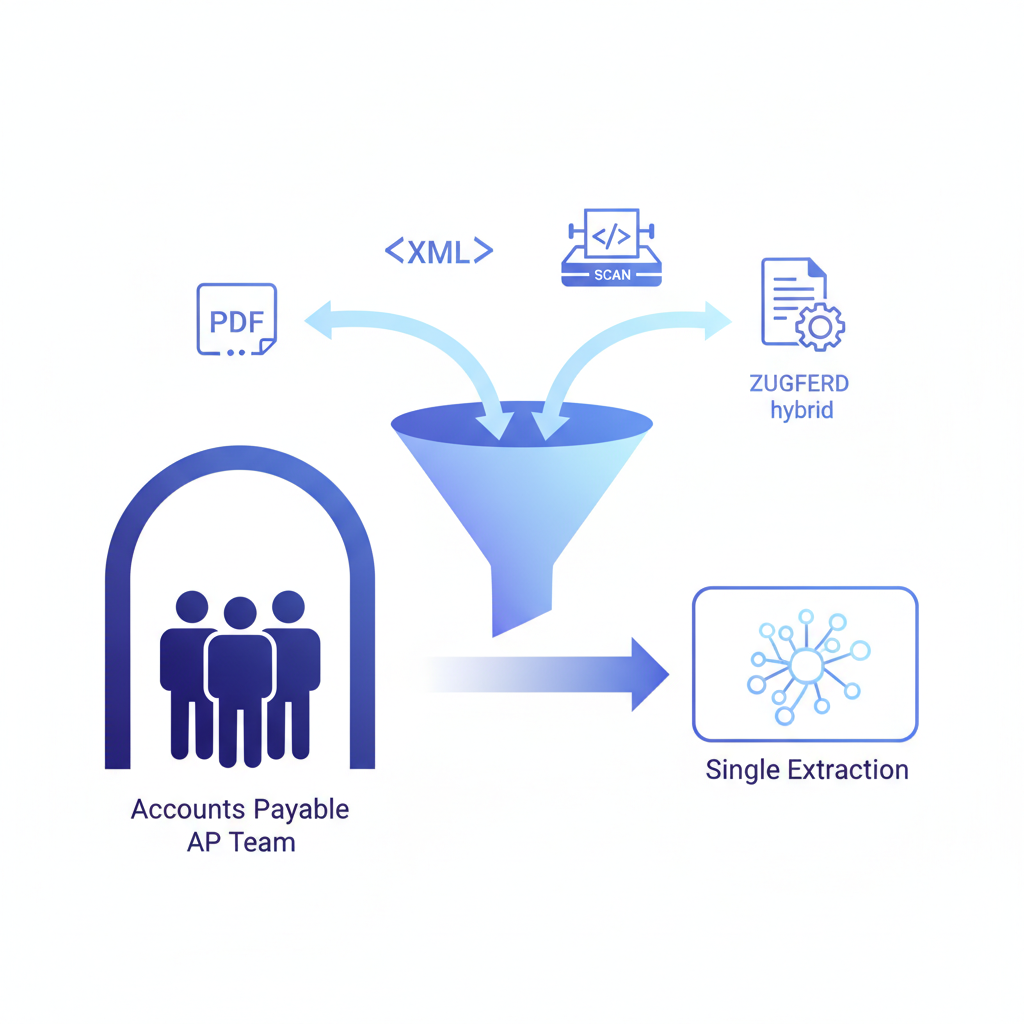
The receiving side is often the overlooked part. Many AP teams have a process for sending invoices, but their inbound queue is a mix of PDFs, scanned paper, ZUGFeRD hybrids, and XML files from Peppol, all arriving in the same email inbox with no consistent handling. That is the real workflow problem.
The Mixed-Format Reality of Most AP Queues
Even in countries with mandatory e-invoicing, AP teams rarely receive 100% structured invoices. Smaller suppliers may not yet be compliant. International suppliers follow different standards. Legacy systems send PDFs. The result is a mixed queue where some invoices are machine-readable and others need extraction.
This is precisely where Invoscope fits. Invoscope is not an e-invoicing network or a compliance platform. It is an AI-powered invoice data extraction tool that handles the invoices that fall outside the e-invoicing pipe: the PDFs, images, and scans that still make up a large share of real AP volume. It processes each invoice in about 5 seconds with 99.2% field accuracy, delivering clean structured data you can export to Excel, CSV, or JSON.
If you are already receiving some XRechnung or Peppol XML files, your ERP or accounting system likely handles those. Invoscope handles everything else, so your AP team has one consistent output format regardless of what format the invoice arrived in.
You can read more about how the extraction process works in the guide to automating invoice processing, which covers the full workflow from ingestion to export.
How Structured Invoice Data Relates to E-Invoicing
Structured invoice data and e-invoicing are related but not identical. E-invoicing is a transmission standard: it defines how a supplier sends data to a buyer. Structured extraction is what happens when you receive a document that did not arrive via an e-invoicing channel and you still need the data in a consistent, queryable format.
Both goals produce the same end state: invoice fields (vendor name, invoice number, date, line items, tax, total) in a structured output your systems can consume. The difference is the input. For AP teams running invoice data extraction workflows, the extraction layer handles the gap between what e-invoicing mandates require and what your suppliers actually send today.
Invoscope's Smart Projects mode is particularly useful here. You can drop a batch of mixed-format invoices into a project and get a single normalized spreadsheet out the other side, regardless of whether individual invoices came in as a PDF, a photo, or a ZUGFeRD hybrid (the visual PDF layer of which Invoscope reads). Learn more about Invoscope's extraction capabilities on the features page.
E-Invoicing and Your AP Workflow: Practical Steps
If you are preparing for an e-invoicing mandate or simply trying to get a handle on a mixed inbound queue, a few practical steps help.
Audit your inbound invoice formats
Before you can build a process, you need to know what you are actually receiving. Spend a week logging inbound invoice formats: PDF via email, PDF via portal, XML attachment, ZUGFeRD PDF, paper scan, and so on. Most AP teams discover they have more variation than they assumed.
Identify which formats your ERP handles natively
Many ERP and accounting platforms (SAP, Microsoft Dynamics, Oracle, even QuickBooks with extensions) have Peppol access points or can import UBL XML. Those invoices may flow in without manual work. The residual volume, usually the majority, still needs extraction.
Build an extraction workflow for the residual
Use a tool like Invoscope for the PDFs, scans, and non-standard formats. At $9.99 per month for the entry plan, the cost is negligible compared to the time saved. You can start on the free tier (10 invoices per month, no credit card required) to validate the workflow before committing to a paid plan.
Standardize your output format
Whether an invoice arrived as Peppol XML or a scanned PDF, your GL coding, 3-way matching, and reporting workflows should consume the same field structure. Building a normalized output template for your extraction layer means downstream processes do not care how the invoice arrived.
Frequently Asked Questions
Is a PDF invoice the same as an e-invoice?
No. A PDF invoice is a visual document; the data lives as text or image content that software must parse. A true e-invoice is a structured file (XML or similar) where every field is tagged and machine-readable from the start, requiring no OCR or extraction step.
Is e-invoicing mandatory in the United States?
Not broadly. The US does not have a federal B2B e-invoicing mandate, though federal contractors must submit invoices electronically through the Invoice Processing Platform (IPP). Several states have their own requirements for government suppliers. Many US businesses encounter e-invoicing requirements when dealing with European or Mexican trading partners.
What is the difference between ZUGFeRD and XRechnung?
ZUGFeRD is a hybrid format: a PDF that contains an embedded XML payload, so it looks like a normal invoice to a human but carries structured data for machines. XRechnung is a pure XML format with no PDF layer, designed specifically for German public-sector invoicing. XRechnung is mandatory for German federal suppliers; ZUGFeRD is accepted in some contexts but is not always a valid substitute for a government mandate.
Can Invoscope process ZUGFeRD or Peppol invoices?
Invoscope reads the visible content of any invoice document, including the PDF layer of a ZUGFeRD hybrid. For pure XML e-invoices like XRechnung or Peppol UBL files, structured data is better consumed directly by your ERP or accounting system using the native XML. Invoscope's strength is handling the mixed queue of PDFs, scans, and images that arrive outside the structured e-invoicing channel.
How does e-invoicing affect accounts payable teams?
E-invoicing can reduce manual data entry for invoices that arrive via compliant channels. The challenge is that most AP teams receive only a portion of their invoices via e-invoicing networks, and the rest still require extraction, validation, and coding. Building a workflow that handles both compliant e-invoices and ordinary PDFs is the practical near-term priority for most AP teams.
Get Started with Invoscope
If your AP queue is a mix of formats and you need clean, structured data out the other side, Invoscope gives you a free tier of 10 invoices per month with no credit card required. Each invoice processes in around 5 seconds at 99.2% field accuracy. Paid plans start at $9.99 per month. Try it now and see how quickly your mixed invoice queue becomes a tidy spreadsheet.
Create your free Invoscope account and process your first invoices today.