
Agentic invoice processing is a style of accounts payable automation where an AI system does more than read invoices: it makes decisions autonomously, routes documents for approval, triggers payments, flags exceptions, and takes follow-up actions without a human initiating each step. Invoscope is not an agentic AP platform. It is a focused AI extraction tool that converts any invoice PDF to clean, structured Excel data in about 5 seconds at 99.2% accuracy. Understanding the difference between those two things will save most SMBs a lot of money and a lot of wasted evaluation time.
What "Agentic" Actually Means in the Context of Invoice Processing
The word comes from AI research. An "agent" is a system that perceives its environment, sets a goal, and takes a sequence of actions to reach that goal, including re-planning when something goes wrong. Applied to invoices, an agentic system might:
- Receive an invoice by email automatically
- Extract the data fields
- Check the PO number against your ERP
- Route to a department head for approval if the amount exceeds a threshold
- Schedule payment in your accounting system once approved
- Send a remittance notice to the supplier
- Archive the record and update the general ledger
Each of those steps happens without a human queuing the next action. The agent drives the whole chain. Vendors like Nanonets have been repositioning their products around this framing, describing their platforms as "agentic AI" for AP. That is a legitimate description for what those platforms do, and it is genuinely useful for organisations with the right infrastructure to support it.
The question is whether that infrastructure requirement and price point make sense for a small or mid-size business right now.
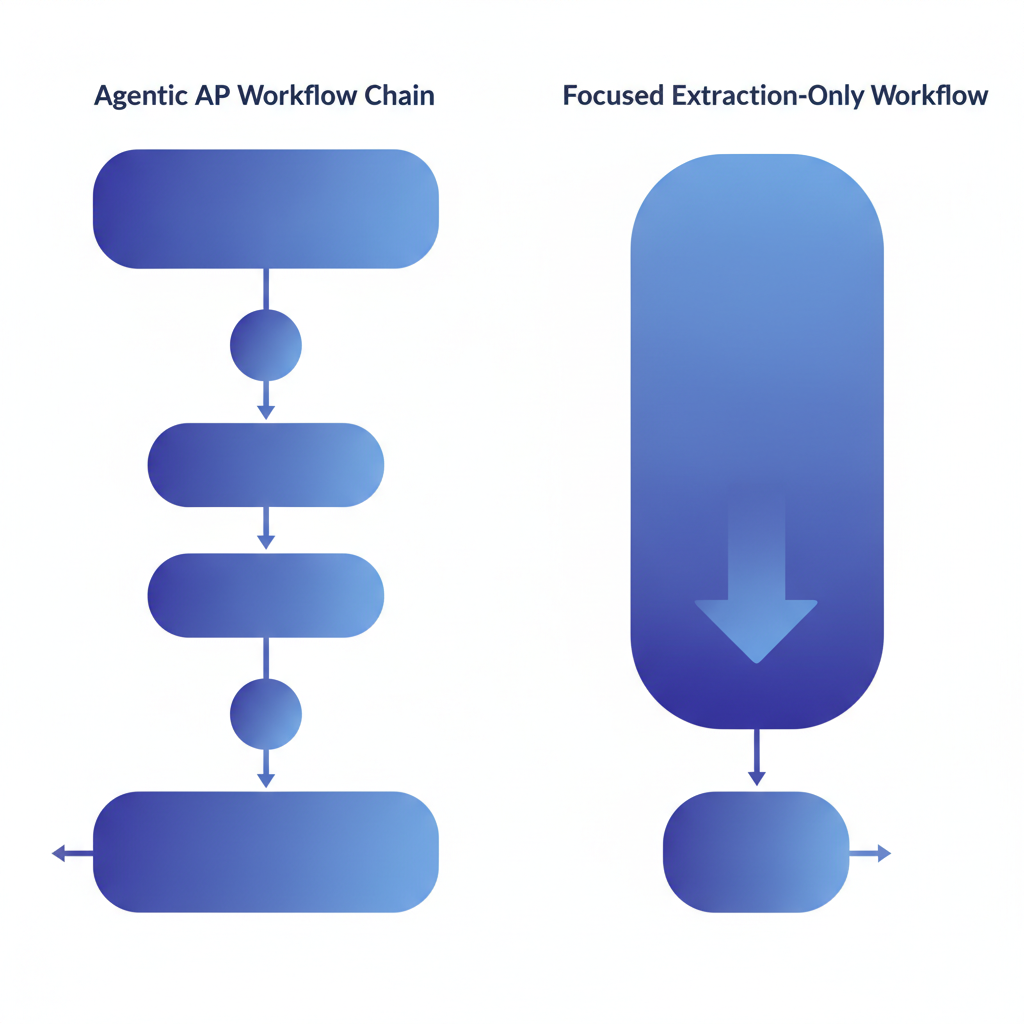
Agentic AP vs. Invoice Data Extraction: A Clear Distinction
Most SMBs shopping for invoice automation tools are solving one of two distinct problems. Agentic AP solves the second one, but only after the first is already handled well.
| Capability | Invoice Data Extraction (Invoscope) | Agentic AP Platform (e.g. Nanonets, enterprise tools) |
|---|---|---|
| Read and parse invoice fields | Yes, core function | Yes, as a foundational step |
| Export to Excel, CSV, or JSON | Yes, every extraction | Sometimes, varies by plan |
| No template setup required | Yes, works on any format | Often requires supplier templates or training |
| Autonomous approval routing | No | Yes, core selling point |
| ERP write-back | No (data export to your ERP) | Yes, with native connectors |
| Payment scheduling | No | Yes, on higher-tier plans |
| 3-way PO matching | No | Yes |
| Free tier available | Yes, 10 invoices per month, no credit card | Rarely, trial periods only |
| Starting price | From $9.99 per month | Typically $500 to $2,000+ per month |
| Implementation time | Minutes | Weeks to months |
| Requires dedicated IT or AP ops team | No | Usually yes |
The gap in starting price is not a rounding error. Enterprise agentic AP platforms are built for organisations processing hundreds or thousands of invoices per month, with formal approval hierarchies, ERP systems like NetSuite or SAP, and a dedicated finance team to manage exceptions. That is not most SMBs.
Why Vendors Are Pushing "Agentic" Right Now
AI vendors have strong commercial incentives to lead with the word "agentic." It commands premium pricing, creates dependency on platform-specific integrations, and signals product sophistication to enterprise procurement committees. Nanonets is a good example: the company built its reputation on document extraction, then pivoted its messaging toward agentic AP to move upmarket and compete with Tipalti, Stampli, and Coupa.
That is a rational business strategy for Nanonets. It is not necessarily good news for an SMB that just needs invoice data in a spreadsheet without re-typing it.
When you read a case study about agentic AP saving a company $400,000 per year, read the footnote carefully. That figure almost always involves an organisation processing 5,000 or more invoices monthly, a team of AP clerks that can be redeployed, and a multi-month implementation. A 12-person logistics company processing 80 invoices a month will not see that return. It will see a 6-month onboarding, a setup fee, and a monthly bill that dwarfs the labor cost it was trying to eliminate.
The Three Questions That Determine Whether an SMB Needs Agentic Features
1. Do you have a formal approval workflow?
Agentic routing is only valuable if your business actually has defined approval tiers: invoices under $500 go straight to payment, $500 to $5,000 need department head sign-off, above $5,000 needs CFO approval, and so on. If your current process is "the owner looks at it and pays it," an autonomous routing engine adds complexity without adding value.
2. Are you processing more than 200 invoices per month?
Below roughly 200 invoices per month, the math on full agentic AP almost never closes. At that volume, automated extraction (getting clean data out of PDFs fast) solves the biggest pain point, which is manual data entry, at a fraction of the cost. You can use that clean data inside whatever approval or payment tool you already have. At 500 or more invoices per month, the calculus starts to shift, particularly if you have multiple approval layers and suppliers across many formats.
3. Is your current bottleneck data entry or decision-making?
This is the most clarifying question. If your team is spending hours each week typing numbers from PDFs into spreadsheets or your accounting system, the bottleneck is data entry. Agentic AP includes an extraction layer, but you are paying for a lot of infrastructure you do not need yet. If your team has clean data but the bottleneck is getting invoices through a multi-person approval queue, then agentic routing genuinely helps. Most SMBs are firmly in the first camp.
What Clean Extraction Solves (and Why It Should Come First)
Extraction is the foundation of any invoice automation, agentic or otherwise. An agentic system that extracts data badly will route incorrect amounts for approval, match wrong PO numbers, and create downstream errors that are expensive to untangle. The accuracy of the extraction layer is the single most important quality signal in any invoice automation tool.
Invoscope processes invoices with 99.2% field accuracy, requires no template setup, and returns structured data in about 5 seconds per invoice. Both operating modes, Quick Analyze for one-off invoices and Smart Projects for batch processing, export directly to Excel or CSV. That clean, structured output can then flow into QuickBooks, Xero, or any approval tool you already use. You can read more about how each mode works on the features page.
For most SMBs, that covers the entire problem. The data gets into the right place accurately and quickly. A human reviews it, makes the payment decision, and moves on. That is not a limitation. That is an appropriately scoped tool for an appropriately scoped problem.
If you are curious about the broader landscape of automation options, the complete guide to automating invoice processing walks through the full spectrum from manual data entry to full AP automation, with honest notes on where each approach makes sense.
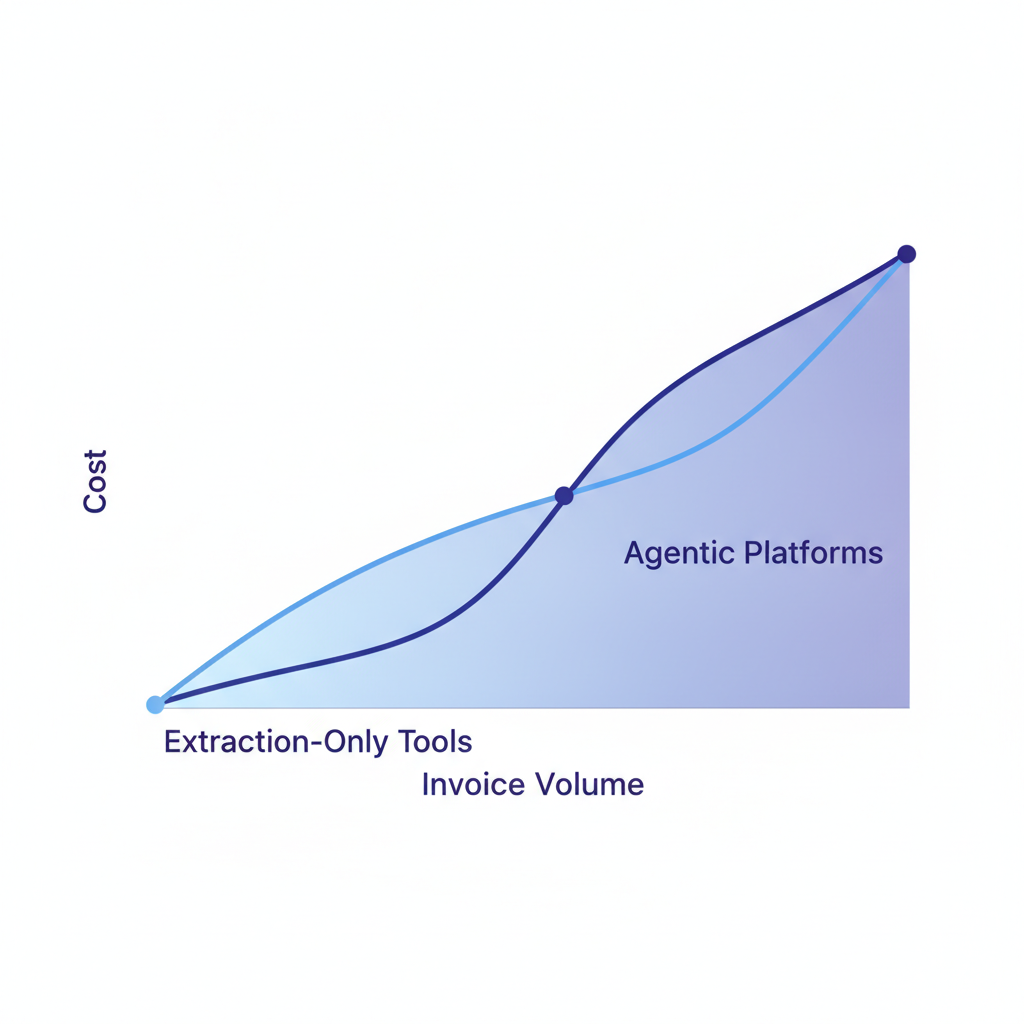
When Agentic Processing Genuinely Makes Sense for a Growing SMB
There are situations where moving toward agentic features is the right call, even for smaller businesses. The indicators are fairly specific:
- You are processing 300 or more invoices per month and growing fast
- You have a documented approval policy with at least two tiers
- Late payment penalties are a recurring line item in your costs
- You have an ERP or accounting platform that supports native API integrations
- You have a finance team member whose primary role is accounts payable
If most of those are true, it is worth evaluating full AP platforms. If two or fewer apply, you are most likely paying for capability you will not use, and you will spend more time on implementation than you save in the first year.
The practical path for most growing SMBs is to start with extraction, get the data quality right, build the spreadsheet or accounting integration that works for your volume today, and revisit agentic AP when the approval bottleneck is actually the constraint. You can always layer agentic tools on top of clean extracted data. You cannot easily fix years of bad data that an improperly configured agentic system wrote into your ERP.
How Invoscope Fits Into a Larger Automation Stack
Invoscope is designed to be the extraction layer in whatever stack you build. It sits at the front of the workflow: invoices come in as PDFs, Invoscope returns structured data in seconds, and that data moves downstream via Excel export, CSV, or the public API. Some customers feed that output directly into QuickBooks manually. Others use Zapier or n8n to push data into their accounting system automatically. A few pipe it into a lightweight approval tool of their own choosing.
None of that requires signing a six-figure enterprise contract or spending three months on implementation. The free tier gives you 10 invoices per month at no cost and no credit card required, so you can test real extraction quality on your actual invoices before committing to anything. Paid plans start at $9.99 per month.
The point is not that agentic AP is bad. The point is that clean, accurate extraction is the prerequisite for any downstream automation to work, and for most SMBs it is also sufficient on its own for quite a long time. Understanding that distinction helps you spend your software budget on the right problem, at the right time.
Ready to see what clean invoice extraction looks like on your own documents? Create a free Invoscope account and process your first 10 invoices at no cost, no credit card needed.
Related reading: how AI invoice processing works, the extraction layer every agentic workflow depends on.
Related reading: What Is Invoice Processing? A Plain-English Guide for Finance and AP Teams
Related reading: How to Import Invoices into QuickBooks: Manual Steps vs Automated Extraction